
Your shopping cart is empty!
Categories
Latest 


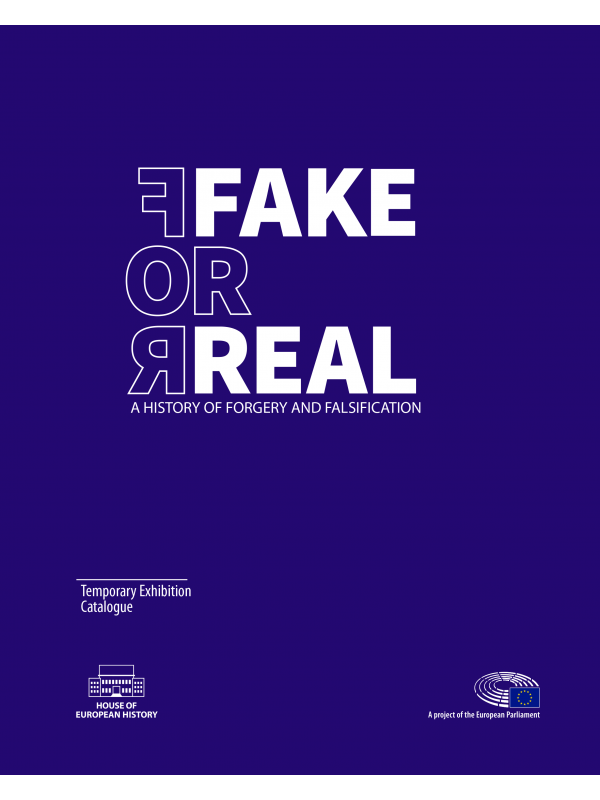
Fake for Real: A history of forgery and falsification

21.99€
Qty:
Fake for Real: A history of forgery and falsification. Temporary exhibition catalogue
Language: English. Category: Counterfeits
The Ancient Greeks, the myth goes, used a wooden horse to deceive their enemies and breach the walls of Troy. Throughout the centuries – in war, politics, the economy and other spheres of human activity – forgery and deceit were used to advance their creators’ goals. Fake for Real: A History of Forgery and Falsification, is an exhibition that explored these themes for more than a year at the House of European History, its Brussels base. Now, it is on a tour around Europe, visiting cities such as Thessaloniki, Sofia, Budapest, Bucharest, Gdansk and Kristianstad.
The exhibition presents falsifications throughout history. It describes the specific historical circumstances that explain their appearance, the interests and motives behind them and the impact they had. It also demonstrates how they were ultimately exposed. Set chronologically across six big themes, Fake for Real displays more than 100 artefacts from the House of European History collection. It also includes films and interactive games.
Each case study tells a story of falsification and deceit: from the alleged Donation of Constantine, manipulated biographies of medieval Christian saints, to forged works of art and counterfeit consumer goods. The exhibition presents a wide range of different objects, art works, images, and historically important documents, maps featuring imaginary territories, treatises on witchcraft and false evidence used to accuse a French artillery officer of espionage — the story that went down in history as the Dreyfus Affair. The final section of the exhibition, titled ‘Era of Post Truth?’ is an interactive space with games and videos, where visitors can become fact-checkers, decide on what gets published or censored and play around with an innovative ‘filter bubble’ to explore how social media work. The exhibition ends with an interactive timeline about Russian disinformation and an immersive artistic installation about the same topic in the context of the current war. All exhibits demonstrate something poignant and unique about how we want to understand the world or deliberately misrepresent it.
Table of contents
INTRODUCTION
Preamble
Foreword
Preface
Why should society dispute historical concepts of truth and fake?
Curatorial introduction to the exhibition
Educational aspects of the exhibition
PART ONE. THE EXHIBITION NARRATIVE
RULING AND PRAYING 33
Case Study 1. Condemned to be forgotten
Case Study 2. The Donation of Constantine
Case Study 3. Forging relics
UNDERSTANDING THE WORLD
Case Study 4. Invented lands and creatures
Case Study 5. Freedom to print
Case Study 6. Forging science: Piltdown Man
UNITING AND DIVIDING
Case Study 7. Forging history: patriotic fakes
Case Study 8. Conspiracy theories: the Protocols of the Elders of Zion
Case Study 9. Forging evidence: the Dreyfus Affair
FIGHTING WAR
Case Study 10. Lifesaving forgeries
Case Study 11. Deceiving the enemy: operation Bodyguard
Case Study 12. Denying crime
FAKE AND FORTUNE
Case Study 13. Han van Meegeren, a master of the art of forgery
Case Study 14. Faking brands
Case Study 15. Counterfeit currency
Case Study 16. The era of post-truth?
PART TWO. DIFFERENT PERSPECTIVES ON FORGERIES IN HISTORY
The medieval notion of truth. The trustworthiness of relics
‘Liars should have good memories’. What we talk about when we talk about forgery (and its debunking)
Fakes, patriotic and otherwise. The past as smoke and mirrors
Why have fakes become crimes?
A fake conquers the world. The Protocols of the Elders of Zion
Fake brands. The Romantic basis of their conceptualisation
How big is the disinformation challenge facing us?
EPILOGUE
Exhibition Team
Editorial Team
House of European History Team
Lenders
Image Credits
| Details | |
| Publisher | Publications Office of the European Union |
| Language | English |
| Pages | 204 |
| Illustrations | color figures |
| Binding | paperback |
| ISBN | 978-92-846-5038-5 |
| Creation date | 2020 |
| Size | 21 х 29 cm |
Write a review
Your Name:Your Review: Note: HTML is not translated!
Rating: Bad Good
Enter the code in the box below:



© “Bibliophilia” Ltd. / © „Библиофилия“ ЕООД