
Your shopping cart is empty!
Categories
Latest 


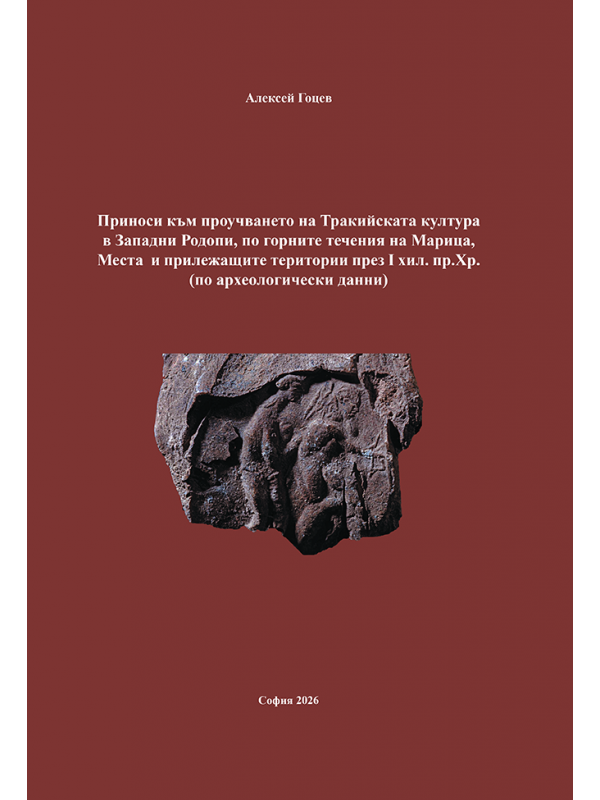
Contributions to the Study of Thracian Culture in the Western Rhodopes, along the Upper Reaches of the Maritsa and Mesta Rivers, and Adjacent Territories during the 1st Millennium BC

24.00€
Qty:
Contributions to the Study of Thracian Culture in the Western Rhodopes, along the Upper Reaches of the Maritsa and Mesta Rivers, and Adjacent Territories during the 1st Millennium BC (Based on Archaeological Data)
Language: Bulgarian with extended summary in English
Category: Thracian archaeology
The history of the Thracian tribes, who inhabited today‘s Bulgarian territories in the late 2nd and the 1st millennium BC, has attracted the attention of academics (archaeologists, historians, numismatists and epigraphers) for more than a century. Over all these years, a large amount of data of various natures has been accumulated, and it seems the time has come for its summarisation, interpretation, and, accordingly, outlining the directions of future research. To the greatest extent, this statement applies to archaeological inquiries, particularly developed in recent years. These new directions are most clearly expressed precisely in the field of Thracian archaeology, displaying a tendency to apply the principles of settlement archaeology.
Basically, this approach includes not only the study of archaeological sites in one way or another, but above all, attempts to trace the connections of various structures (settlements, necropolises, cult centres, roads, metal mining and production centres, etc.) with the surrounding paleoenvironment, taking into account their mutual influences to determine the ways and intensity of cultural development. This relationship between the natural environment and human activity is most accurately traced in separate, isolated areas, and in this way, the basic laws of evolution and their possible universality are clarified when considering larger territories.
Beyond doubt, a promising region for such research is the lands of the Northwestern Rhodopes, along the upper and middle reaches of the Mesta and Maritsa rivers, as well as the mountainous or semi-mountainous valleys between them. The natural prerequisites for this are the significant amounts of reserves – metal ores and the numerous mineral springs.
Although no localised and studied metal mining centre can be definitively linked to antiquity and thus confirm its past exploitation, at this stage of knowledge, the data on active mining activity in the area under consideration are indirect, but still very definitive.
However, the natural features of the region would only be a background for all sorts of interpretations if we did not have a serious archaeological source base accumulated over the last 30-40 years. First of all, mention should be made of the total field surveys of entire regions in Southwestern Bulgaria, carried out by the Bulgarian-Polish expedition in the 1970s and early 1980s under the leadership of Prof. M. Domaradzki. The collected database of sites from Prehistory, Antiquity and the Middle Ages is a solid ground for conclusions of various nature.
The archaeological situation along Mesta is interesting, the data are more and, respectively, the possibilities for conclusions are much greater. A certain similarity of the processes is also observed in the territory along Upper Maritsa, with its adjacent territories - the NW Rhodopes and Sredna Gora.
Geographical and chronological borders
To determine the exact borders that separate and distinguish an area from the surrounding lands in some respect is a complex and delicate, yet extremely necessary task in any archaeological study.
When analysing the archaeological situation on the territory, which we can generally denote as Southwestern Bulgaria, it becomes apparent that its eastern half is much better explored, and the available source base is incomparable to that associated with the western part.
This circumstance required presenting the data from the analysis and conclusions for the region encompassing the lands of the Western Rhodopes, the upper reaches of the Mesta and Maritsa rivers and their adjacent territories only in a summarised form.
Table of contents
Рецензия от проф. д.н.к. д-р Васил Марков
Благодарности
Увод
Географски и хронологически граници
История на проучванията. Историография и състояние на изворовата база
Спасителни разкопки — местоположение, обхват, плюсове и минуси
Западни Родопи и долината на р. Места
Водосборният район на Горна Марица
Chapter 1. Brief description of the Late Bronze Age and the transition to the Early Iron Age
Chapter 2. Features of the Late Iron Age. Settlements, cult centers, necropolises
Селищна система през КЖЕ
Емпорион Пистирос
Тракийски светилища
Тракийски светилища от Западните Родопи
Погребални практики
Chapter 3. Pottery complex, armament and jewellery
Керамичен комплекс
Въоръжение
Накити
Коментар към Керамични комплекси, въоръжение, накити. Наблюдения, изводи, перспективи
Финални думи
Резюме на английски език
Библиография
Списък на съкращенията
Приложения
| Details | |
| Publisher | ProVias |
| Language | Bulgarian with a summary in English) |
| Pages | 242 |
| Illustrations | b/w and colour figures, maps |
| Binding | hardback |
| ISBN | 978-619-92562-9-9 |
| Creation date | 2026 |
| Size | 21 х 29 cm |
Write a review
Your Name:Your Review: Note: HTML is not translated!
Rating: Bad Good
Enter the code in the box below:




© “Bibliophilia” Ltd. / © „Библиофилия“ ЕООД